
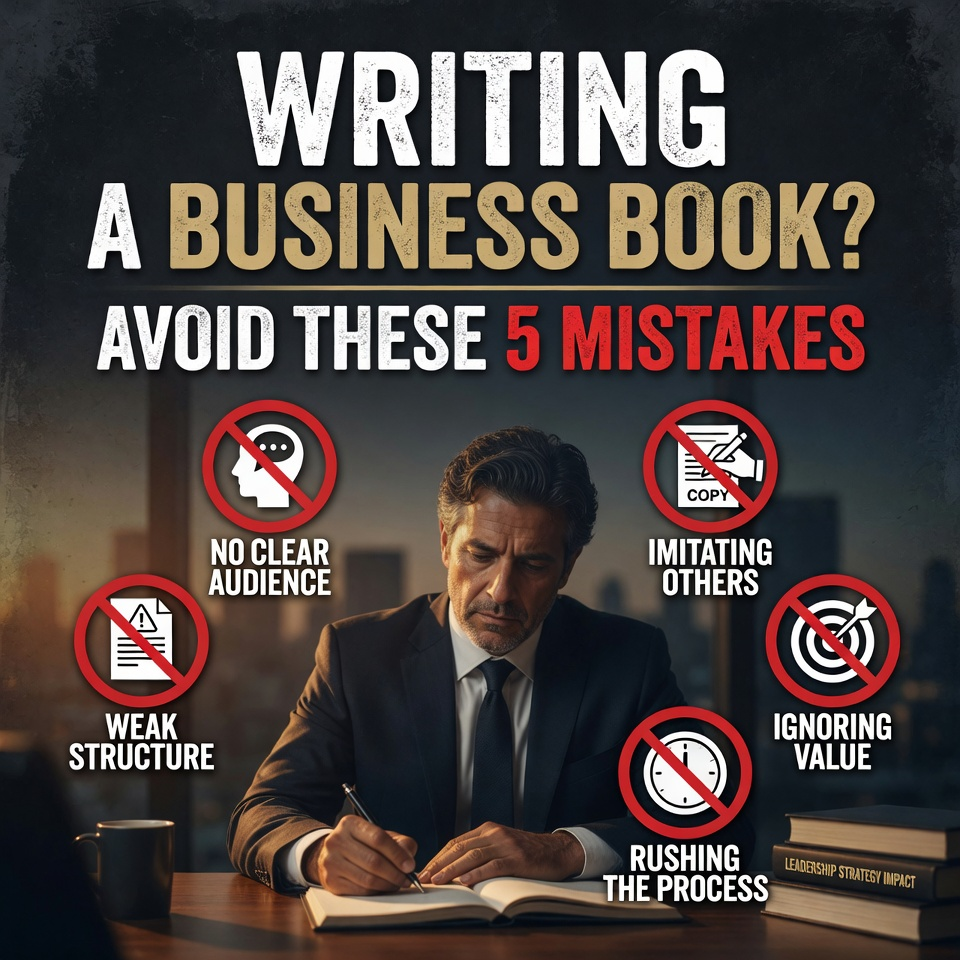
Writing a Business Book?
Avoid These 5 Mistakes
A business book is one of the highest-leverage things you can do for your brand — or one of the most expensive mistakes you make. The difference comes down to five decisions.
Writing a business book is one of the highest-leverage things you can do for your brand. It can also be one of the most expensive mistakes you make — if you go in without understanding where most business books go wrong.
The problems aren’t usually about writing skill or effort. They’re about decisions made early in the process that seem minor but compound into a book that doesn’t serve its purpose. A book that doesn’t attract the clients it was supposed to attract. A book that sits on your shelf looking impressive while delivering almost nothing to your business.
Here are the five biggest mistakes — and what to do instead.kill book ROI
done properly
time split (wrong)
with no CTA
Naming the Book for Yourself Instead of Your Reader
The book title that sounds brilliant to you is often the title that communicates nothing to the person you’re trying to reach. An author picks a title reflecting internal brand language or a proprietary methodology name — meaningful to existing clients, noise to a cold reader on Amazon.
A title like “The Velocity Framework” might be meaningful to your existing clients who’ve heard you talk about it. To a stranger deciding whether to click, it’s noise. Your title and subtitle exist for one purpose: to make the right reader immediately recognize that this book is for them.
“If a stranger in my ideal client profile saw only this title in an Amazon search result, would they know this book was for them?” If the answer is no, keep working.
“How [Audience] Can [Do Specific Thing] to [Achieve Specific Result]“
It’s not glamorous. It converts.
Over-Protecting Your “Secret Sauce”
This one is counterintuitive, so pay attention. Many business authors hold back their best material — the specific frameworks, the detailed processes, the proprietary insights that actually work — behind a consulting engagement. The thinking: “If I give everything away, why would anyone hire me?” The reality: the opposite is true.
✕ Holding Back
Produces books that feel thin. Thin books don’t generate the trust that translates into premium client relationships. Readers feel like they got a sales pitch, not real value.
✓ Giving It All Away
A reader who gets genuine value doesn’t feel like they don’t need you. They feel like they understand your approach, trust your thinking, and want you to help them apply it.
The book builds the case. The case generates the hire. Give away your best work. It comes back to you many times over.
Writing Without a Clear Call to Action
A business book without a clear next step is a dead end. If a reader finishes your book, puts it down, thinks “that was great,” and moves on — you’ve failed to capitalize on the most high-value moment in the relationship.
Common Effective CTAs in Business Books
- A lead magnet — a free resource that extends the book’s value and captures their email address
- A discovery call invitation for your services
- A community, course, or membership they can join
- A website where they can access additional resources and learn about working with you
The right CTA depends on your business model. But the wrong CTA is no CTA — which leaves your best readers stranded at the end of an excellent book with nowhere to go.
Ignoring Nonfiction Book Promotion Basics
Most business authors spend 95% of their energy on writing the book and 5% on getting it read. That ratio produces a book that exists in isolation — well-written, properly published, and almost completely invisible.
Promotion is not an afterthought. It’s half the job.
The Fundamental Promotional Infrastructure You Need
- Professional Amazon listing optimization — title, subtitle, keywords, description, categories
- IngramSpark distribution to get into booksellers and library systems
- A media kit and podcast pitch ready for outreach
- An author website that positions you clearly and captures readers’ contact information
- A review acquisition strategy for the launch window
Underestimating How Long It Actually Takes
The number one cause of low-quality business books: rushing. An author sets an arbitrary deadline tied to an event or personal milestone, and production gets compressed. The result is a book that looks like a draft — because it is.
If you’re trying to do it in six weeks, something essential is getting cut
Budget the time. The book will be in the world representing you for years. Spending the time to do it right is not optional — it’s the investment.
The Pattern Behind All Five Mistakes
They all come from treating the book as a project, not an asset.Look at the five mistakes together and you’ll notice a theme: they all come from treating the book as a project to complete rather than an asset to build. A project is finished when it’s done. An asset is built to perform — to represent your expertise, attract the right clients, generate speaking opportunities, and compound value over time.
That frame changes every decision: the title, the content, the production quality, the launch strategy, the back-matter call to action. Build the asset. Take the time to do it right. The returns will justify it.
Ready to Build a Business Book
That Actually Works?
The Authority Book Blueprint covers the full framework — from positioning and structure to production and promotion — for a business book that generates real results.
Download the Authority Book Blueprint →Free access · No credit card required · Speakers, coaches & entrepreneurs